
GDC Releases in Peach County Cases
The Georgia Department of Corrections is a statewide state-prison system. It is not a jail in Peach County and does not replace the Peach County Sheriff's booking and release record. A defendant may begin in the Peach County Jail before trial or sentence, then enter GDC after a felony prison sentence. At that point, the state offender record becomes the main public route for current prison location, sentence information, and state release status.
A transfer from the county jail to GDC ends county custody but does not release the person into the community. GDC may first place the person through a diagnostic or classification process and later assign a state institution. Community release can occur through parole or when the state term reaches its lawful end. The actual state event should be confirmed in GDC, Board, and supervision records rather than inferred from the date the person disappeared from a county source.
Search GDC Peach County Releases
The official GDC Find an Offender page supports searches by name, description, ID, or case number. Begin with the most precise identifier available. Name-only results can include similar people, so match the conviction county, offense, physical description, sentence, aliases, and incarceration history before relying on a record.
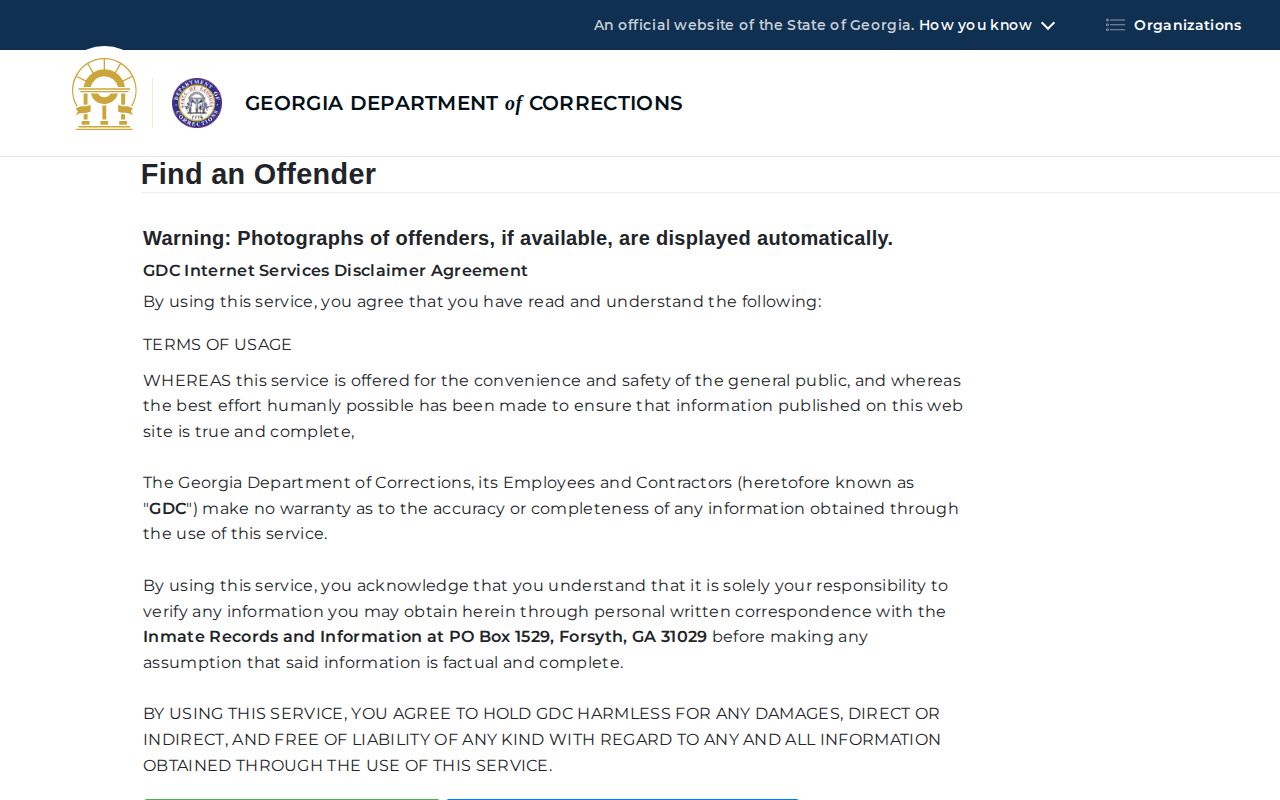
The captured GDC search entry shows the statewide route and warns that available photographs display automatically.
- Open Find an Offender and choose a search method.
- Enter the legal name, GDC ID, case number, or supported description fields.
- Compare all returned identity and Peach County conviction details.
- Open the correct state record and review institution, sentence, release-date, and status fields together.
- Use GDC's written verification route when the public entry must be confirmed.
GDC Release Record Fields
A GDC result provides more state-sentence detail than a county release entry. The most useful release fields must still be read in context. A maximum date is not the same as an actual release, and an actual release date should be paired with current status. The incarceration history can also show earlier periods that should not be mistaken for the current sentence.
| GDC field | What it helps confirm |
|---|---|
| Name and GDC ID | The identity tied to the state record |
| Case number and conviction county | The Peach County sentence connection |
| Most recent institution | State placement while custody is active |
| Maximum Possible Release Date | The maximum sentence endpoint, exclusive of parole decisions |
| Actual Release Date | A recorded state release when populated |
| Current Status | Active, parole, inactive, or another displayed state status |
| Sentence and incarceration history | Offense, length, and prior state custody periods |
A person still serving may show the actual release field as currently serving and the status as active. A released offender may show an actual date with an inactive or parole-type status. GDC does not confirm a short Peach County jail-only stay when the person never entered state custody.
Verify Georgia State Release Records
GDC states that users are responsible for verifying public search information before assuming it is complete and factual. Its offender-search disclaimer directs written correspondence to Inmate Records and Information, PO Box 1529, Forsyth, GA 31029. A request should include the person's name, GDC ID, date of birth if known, conviction county, and the exact state fields that need confirmation.
GDC Inmate Records and InformationPO Box 1529
Forsyth, GA 31029
Georgia Department of Corrections
300 Patrol Road
Forsyth, GA 31029
Inmate concerns: 404-656-4661
Ask for the actual release date, current status, maximum release date, sentence, and incarceration history as needed. A narrow request is easier to match than a broad request for every record. GDC owns state computation and release data, while the Peach County Superior Court Clerk owns the filed sentencing and jail-credit orders in the county conviction file.
GDC Dates and Parole Status
GDC uses Maximum Release Date, or MRD, for the date a sentence would be fully served apart from parole decisions. The Georgia State Board of Pardons and Paroles uses Tentative Parole Month, or TPM. A TPM is a planning month, not a final promise. Misconduct, unmet conditions, or later Board action can postpone or cancel it.
The Board says many eligible people receive automatic parole consideration. Under the general rule in O.C.G.A. 42-9-45, eligibility can arise after nine months or one-third of the sentence, whichever is greater, unless another rule applies. Serious violent felony sentences have different limits under O.C.G.A. 17-10-6.1. The Board says qualifying non-life serious violent felony terms for offenses committed on or after January 1, 1995 require service of the full prison term.
GDC's Performance Incentive Credit program may reduce a TPM or MRD by one to twelve months for eligible people who earn up to twelve points through case-plan, education, work, and conduct measures. Exclusions documented by GDC include short sentences, life sentences, mandatory or non-parole-eligible terms, death sentences, and probationers. These rules explain why one displayed date should never be treated as fixed without current verification.
Peach County Release Date Corrections
A state date can change because of jail-time credit, an amended sentence, a court correction, consecutive terms, institutional conduct, program completion, parole reconsideration, revocation, or a legal change. GDC says an inmate who believes a computation is wrong should begin with the counselor and use the grievance process if the issue remains unresolved.
The sentencing court may also be needed. For a Peach County conviction, the Superior Court Clerk can provide the sentence or jail-credit order that GDC applies. The Clerk is listed at 205 W. Church Street, PO Box 389, Fort Valley, GA 31030, phone 478-825-5331. The court record proves what was ordered, while GDC explains how the state sentence is computed.
Supervision After a GDC Release
Leaving state prison does not always end state control. The Board's parolee search can show a parole begin date, end date, office, office number, and primary offense when available. The Department of Community Supervision supervises felony individuals in the community on parole, reprieve, probation, and split sentences.
Peach County is served by the DCS Macon Field Office at 640 North Avenue, Suite D, Macon, GA 31211. Published hours are Monday through Friday, 8:00 a.m. to 4:30 p.m.; phone 478-751-6092. DCS assigns supervision by residence rather than simply by whether the person is called a parolee or probationer. The Peach County Parole / Probation page explains the separate Board and DCS checks.
GDC Versus Other Release Systems
The right system depends on the sentence and agency. GDC is authoritative for state prison custody after admission. It does not become the source for every person arrested in Peach County.
| Custody event | Correct source |
|---|---|
| Local jail bond, order, or county term | Peach County Sheriff and court |
| Transfer into state prison | GDC Find an Offender |
| State parole decision | State Board TPM and parole records |
| Felony community supervision | DCS |
| Federal prison sentence | BOP Inmate Locator |
| Immigration detention | ICE ODLS |
The broader Peach County released inmate record path helps identify which system should be checked when the receiving agency is not yet known.
GDC Release and Board Records
The public offender search may answer a basic status question, but a formal parole or discharge document belongs to the agency that issued it. The State Board of Pardons and Paroles maintains the TPM and parolee tools for public status checks. Board files can include parole certificates, conditional transfers, supervised reprieve orders, discharge orders, revocation orders, and other clemency actions.
Georgia Archives lists clemency actions as permanent records. It lists parole case-file materials and letters with a 20-year retention period. Those schedules are specific to Board records and should not be applied to every GDC or Peach County jail file. When a public lookup lacks detail, identify whether GDC, the Board, DCS, or the sentencing court created the document before submitting a request.
A state discharge order and a county jail release entry answer different questions. The first concerns the state sentence or Board action. The second documents when local custody ended. Keeping the issuing agency clear prevents a request from being sent to an office that never held the record.
For a Peach County sentenced felony case, preserve the GDC ID and county case number with any request. Those identifiers connect the statewide offender entry to the local judgment and reduce the risk of mixing people with similar names. If parole follows prison, the Board record explains the release decision and DCS records address community supervision. None of those documents changes the historic fact of when Peach County Jail transferred the person into state custody.