
Peach County Parole or Probation
Georgia divides authority among three public bodies. The Georgia State Board of Pardons and Paroles decides whether an eligible state prisoner receives parole. Peach County Superior Court imposes felony probation and split sentences. The Georgia Department of Community Supervision, or DCS, then supervises people in the community under parole, reprieve, probation, or a split sentence.
These roles can overlap. A person may finish prison on parole, report to DCS, and still have a court case record that shows the sentence. Another person may receive probation from the court and never have a Board parole record. The comparison helps identify the right source.
| Point | Parole | Probation |
|---|---|---|
| Who orders it | State Board of Pardons and Paroles | Sentencing court |
| When it begins | After part of a prison term | At sentencing, or after prison in a split sentence |
| Public verification | Board TPM or Parolee tools | Court sentence and docket |
| Community supervision | DCS | DCS for adult felony probation |
- Parole
- Conditional release from prison before the sentence fully expires.
- Probation
- A court-ordered sentence served in the community under stated terms.
- Split sentence
- A sentence combining confinement with a later term of probation.
- Discharge
- The formal end of parole or probation authority.
Verify Peach County Post-Release Supervision
Start with the custody history, not an assumption. A bond release from Peach County Jail does not create parole. If the person served a GDC sentence, check state corrections and Board records. If the Peach County court imposed probation, the signed sentence is the source that establishes it.
- Search the GDC Find an Offender record by name, ID, description, or case number. Read current status and actual release date.
- If the person is still in prison, use the Board's TPM Lookup explanation. A TPM is a tentative parole month, not a final date.
- For a released parolee, use the Board Parolee Database linked from the Board home page. Results may show parole start and end dates, office, office number, and primary offense.
- For probation, request or review the sentence through the Peach County Superior Court Clerk. The court record, not the Board, proves the probation term.
- Confirm local assignment with the DCS Macon Field Office. DCS routes cases by residence, so parole and probation cases may report to the same office.
The broader Peach County released inmate search explains how to distinguish a jail bond-out, a transfer to GDC, and a final release. That distinction should be settled before interpreting a supervision result.
Note: A missing online result does not prove that supervision ended; verify the sentence and ask the agency that owns the record.
Peach County DCS Office Route
Peach County does not have its own DCS field office in the sources reviewed. The local route is the DCS Macon Field Office, which serves Bibb, Crawford, Peach, and the Macon Circuit. DCS assigns cases by the person's residence rather than by the label parole or probation. That is why two people with different sentence types may report through the same office.
640 North Avenue, Suite D
Macon, GA 31211
Monday-Friday, 8:00 a.m.-4:30 p.m.
Phone: 478-751-6092
Fax: 478-216-2123
Coordinating Chief: Nakeycha Hooks
Ask office staff about office routing or the proper records channel, not for legal advice. Formal DCS records requests go through the agency's open-records custodian. The Board remains responsible for parole decisions, while Peach County Superior Court remains responsible for the terms of probation.
The official Macon office page shows the local supervision contact and service area.
View the DCS Macon Field Office source before calling so the address and hours can be checked for updates.
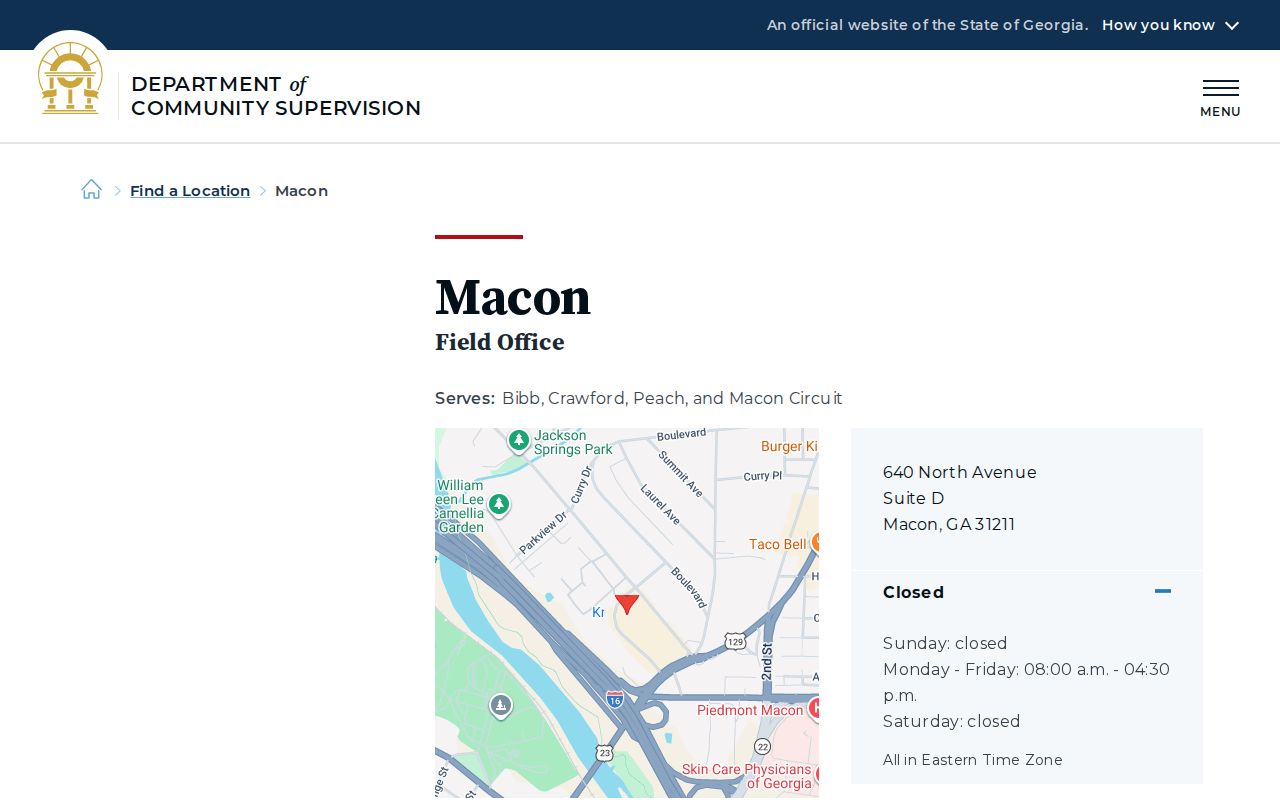
This office listing grounds Peach County supervision questions in the correct regional DCS location.
Peach County Parole Decision Records
Georgia does not publish a county-style hearing docket for each routine parole case. Public Board meetings may occur monthly, but the Board states those are business meetings where parole cases are not considered and parole decisions are not made. A meeting agenda therefore cannot confirm whether one Peach County inmate will be released.
Use the Inmate TPM Lookup for pre-release timing and the Parolee Database for a person already on parole. For a non-life, parole-eligible sentence, the Board may set a future TPM or deny parole. At final review it may set a parole release date, postpone the month, or cancel it because of misconduct or unmet conditions. Life-sentence decisions are grant or deny, not a TPM result. Board notices appear through its press-release and meeting page, but individual status belongs in the person-specific tools.
The Board's parole-process page explains automatic consideration and the decision path.
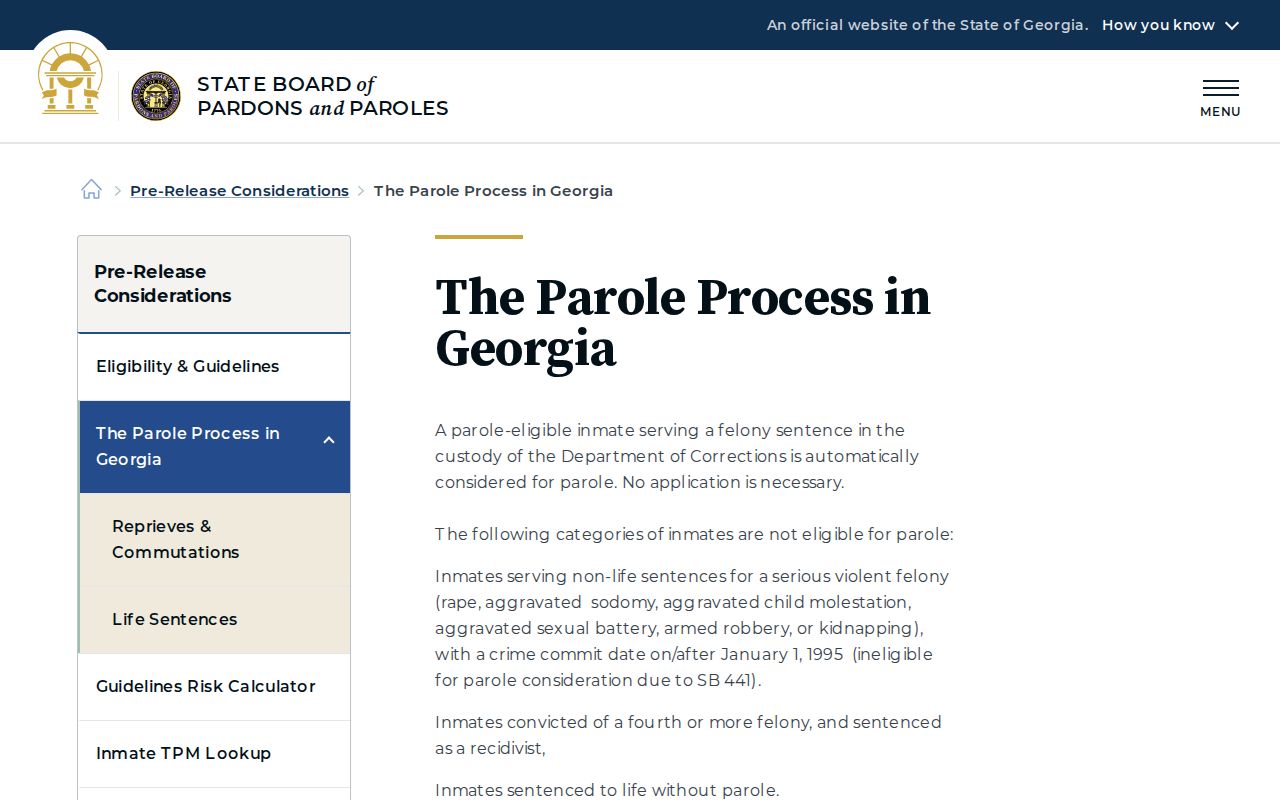
The process page is the better source for case timing than a public business-meeting calendar.
Peach County Warrants and Violations
No official Peach County-specific absconder list was found in the sheriff sources reviewed. An absconder is a supervised person whose location is unknown after failing to report as required. It is not the same as a person who simply moved or changed offices. A violation is an alleged breach of supervision terms, and a revocation is a later official action that can return a person to custody.
Check the agency tied to the action. DCS holds supervision information, the Board handles parole decisions and parole revocation authority, and the court docket can show probation warrants or revocation proceedings. The Peach County Sheriff's Office may confirm a locally issued warrant, but an old jail release record does not show every later event. Avoid treating a VINE status change as proof of a supervision violation.
Correct Peach County Release Credits
Errors in jail-time credit or a state release calculation follow a defined path. GDC advises the incarcerated person to begin with a counselor. If the issue is not resolved, the person may use the grievance process. Some disputes depend on the sentencing order or credit paperwork, so the clerk in the county of conviction may also be needed.
For a Peach County conviction, the Peach County Superior Court Clerk keeps the sentence record. GDC remains the state computation agency; the clerk does not replace its calculation. The Board, in turn, handles a TPM or parole decision rather than a maximum-release-date error. Keeping those roles separate prevents a request from being sent to an office that cannot change the field.
Note: Ask for the underlying sentence or credit order when a displayed date conflicts with the court record.
Peach County Supervision Discharge
Supervision ends through an official discharge or expiration, not merely because an online result disappears. A parole end date may appear in the Board's parolee record. Probation completion is tied to the court sentence and any later order. DCS can identify the supervising office and appropriate record channel, but it does not rewrite a Peach County sentence or make the Board's parole choice.
Georgia Archives schedules treat Board clemency actions, including parole certificates, discharge orders, revocations, pardons, and restorations of rights, as permanent records. Other parole case-file materials and letters have a listed twenty-year retention period. No local retention period for Peach County jail supervision-related records was found, so a requester should ask the custodian what existing record documents completion.
Public Record Search
Sponsored Results
Read Peach County Supervision Terms
A reprieve is a temporary suspension of punishment through clemency authority. It is not probation. A split sentence combines prison with a later probation term. Conditions are case-specific and may involve reporting, payment, treatment, travel limits, or compliance with court and officer instructions. No condition should be assumed without the order.
Parole consideration is automatic for an eligible person in GDC custody, and no paid application is needed. General eligibility often begins after nine months or one-third of a felony term, whichever is greater, but other laws control serious violent felony, repeat-offender, and life-without-parole cases. Eligibility only means review may occur. It does not guarantee release.
When a term appears to have ended, check the discharge record, court order, or parole end field. A past release date proves only that custody changed. It does not prove that every later duty ended. Keep the sentence, later orders, and the agency's final record together so that a missing online result is not mistaken for a formal discharge.
The Board's parole and corrections call center is 404-656-4661. Use it for Board routing rather than a DCS field assignment or court sentence question. A clear request names the person, GDC number when known, and the exact record sought. Do not send money to a person claiming that payment can secure parole consideration.
Trace Peach County Probation Orders
Probation questions should begin with the Peach County sentence, not a parole search. The Superior Court record can show whether the judge ordered a fully probated term or a split sentence after confinement. DCS can then confirm office routing by residence. This sequence preserves the line between the court's sentence, DCS supervision, and the Board's separate parole power.
If a later revocation or amendment changes the term, obtain that order too. An old sentence may no longer state the full current status. Ask for the case number, date of the latest order, and the office that now holds supervision.